Start Before You Feel Ready
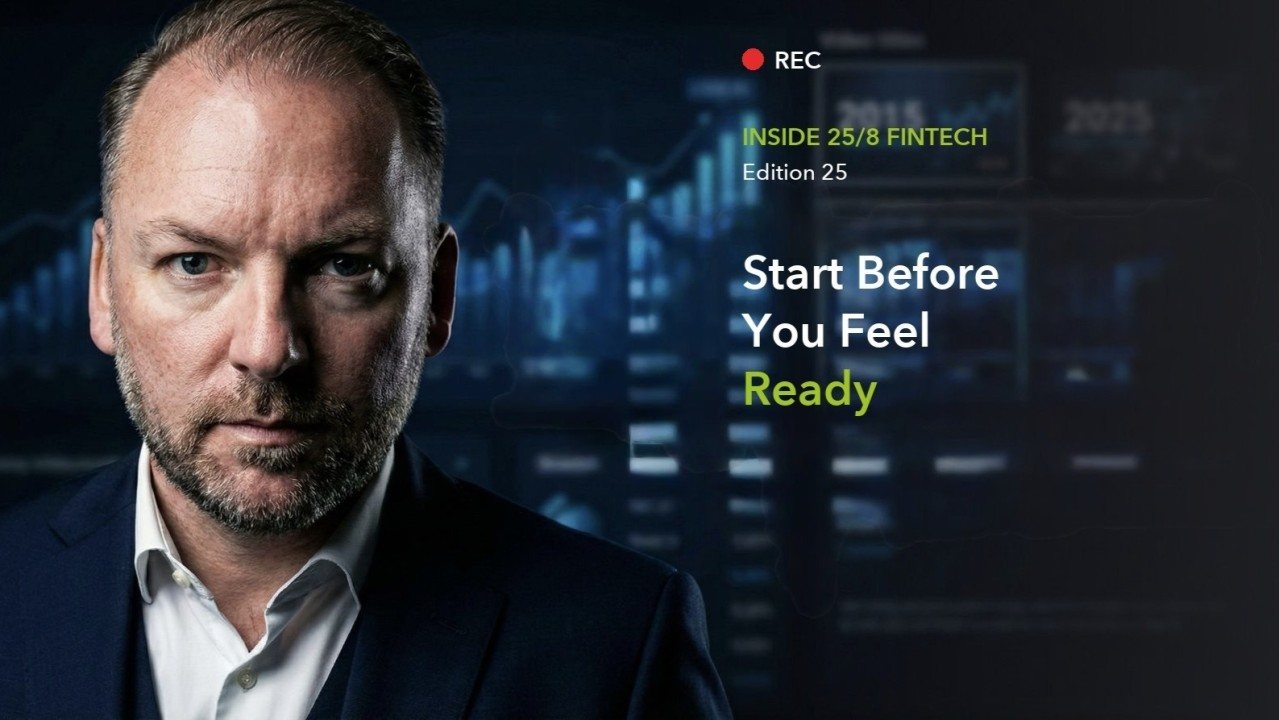
Hello and welcome back to Inside 25/8 Fintech.
When I put this week's five posts side by side, I noticed something I had not planned. A support call from 2018, an escape room in March 2020, a notebook from 1997, a green sheet of paper on a wall and a dictation device. Five different stories, and every one of them started small, long before anyone felt ready.
Every one of them was also sparked by someone in my network. So this edition is a thank you to five people whose posts made me stop and think.
1. Nobody Knows in Advance
"What would you do differently today?" Dr. Johannes Braith asked that under the story of how he started Storebox, living on pasta with pesto in the early days. My honest answer: not much. In hindsight it is easy to know better. In the moment, what counts is that you start at all.
It reminded me of Jensen Huang on the podcast "Acquired" in October 2023. Asked which company he would start at 30, he said: "I wouldn't do it." Building Nvidia had been "a million times harder" than he expected. And the superpower of an entrepreneur, he said, is not knowing how hard it will be.
I know that feeling from March 2020. Overnight, all six of our escape room locations were closed. Two weeks of worries, then seven days to build a completely new game you could play online from home. Nobody could have told me that in advance.
On Tuesday I asked you the same question: if you had known everything beforehand, would you still have started?
2. You Get Ready by Pressing Record
Andreas Herb wrote about the season finale of "Die Höhle der Löwen". He never wanted to be on TV. A producer talked him into it, and at 55 he experienced something completely new. Positive examples like his move entrepreneurial thinking in the DACH region forward, step by step.
My own start in front of the camera was far less glamorous. In June 2010 too few people signed up for a rhetoric seminar. Instead of cancelling, my wife Nadine and I stayed in the booked room and recorded 29 videos for my first online training platform. I didn't know yet that you can cut a video, so every slip meant: back to the beginning.
A year later my "studio" was a green sheet of A3 paper taped to the wall. In January 2015 I started my business vlog: a new video every Monday, no matter how the week before had gone. Some Mondays I sat in front of my iPhone camera without a single idea. I pressed record anyway.
Nobody is ready the first time. You get ready by pressing record.
3. The Notebook Was the Real Gain
In early October Kambis Kohansal Vajargah wrote about financial education for children, with sweets as one of the first lessons about money. Under his post I wrote that in trading, adults often pay thousands to learn what a child learns for the price of a bag of gummy bears: a small loss you feel today protects you from a big one later.
My own first lesson started on 21 November 1997, with a fund, not a share. I was 16. No apps, no live prices. Every day I copied the prices out of the newspaper and drew the charts by hand.
Looking back, the real gain was the notebook, not the trade. My amounts were small, and so was the price of every lesson. The same lesson twenty years later, with more money and more confidence, costs a lot more.
This is my personal experience, not investment advice. But if your kids want to start, let them start small. And give them a notebook.
4. AI Starts at Your Own Desk. Support Ends With a Human.
A few weeks ago Dominic von Proeck Sr. put it in one clear title: stop building AI lighthouses. First personal productivity, then the few processes in the team that carry most of the work, and only then an AI task force.
My small piece of AI is a routine I have had since commercial school. Back then it was shorthand, later a dictation device. Today I speak my thoughts out loud and AI turns them into a first draft. The tool changed three times, the routine stayed the same. The thoughts, the stories and the opinion are still mine.
But there is a limit, and Amelie Kaijo showed it with a story about a tool her team relied on. A critical bug, a factual email, no answer. A second chance, the same bug. Then the cancellation. A good bot can answer the FAQ at midnight. When something breaks that nobody has seen before, a customer needs a human who responds quickly.
I learned that in October 2018, when I called an unhappy customer back myself and then told my colleague: "You reacted exactly right." Sales brings the customers. Support has to keep them.
________________
A start on pasta with pesto, a notebook, a green sheet of paper, a dictation device and one phone call. Five stories, one thread: you don't start because you are ready. You get ready because you start.
So here is my invitation for this weekend: pick one small thing you have been waiting to feel ready for. Not the big project, just the first small step. And take it next week.
Thank you, as always, for reading. And thank you to Amelie, Johannes, Kambis, Andreas and Dominic for the posts that started these thoughts.
Stay focused and trust the process.
Your Thomas
Get the next edition
Every Saturday on LinkedIn.